Many studies, and my personal experience, have shown that the trees with the biggest canopies, and the healthiest trees, are those with more frequent, regular, and shallower irrigations. The moisture in the deep soils is useful for sheer survival, but relatively unimportant to good growth and/or sheer productivity. The biology behind this phenomenon is quite interesting.
The upper layers of the soil are the most aerobic, with the highest population of air-loving bacteria. It is these bacteria that are most responsible for the liberation of mineralized (unavailable) nutrients into a soluble form that the plant can absorb. Thus, the upper horizon of the soil is where the greatest amount of nutrients is liberated. The plant can only absorb these nutrients by taking them in as compounds in a water solution. If the soil is too dry to allow for moisture absorption, than nutrient uptake is inhibited. Allowing the upper soil to dry out between infrequent irrigations means that nutrient uptake also "dries up". Then, when plenty of water is supplied, the soil is saturated to the point that roots and air-loving soil bacteria are stressed or killed from too much water--and nutrient uptake is inhibited, but in a inverse way. It also takes some time for the air-loving soil bacteria to repopulated either the too wet or too dry soil, so there is a biological lag before the roots get their best meals. Infrequent and deep irrigations tend to produce two points in the cycle where the soil life is damaged enough to reduce or prevent growth.
The old deep-watering guideline doesn't, in my opinion, apply to food-bearing trees or plants. Across the board, more frequent irrigations, if done so as to avoid puddling or flooding, produce the highest yields (or, in the case or ornamentals, good-looking foliage growth). The upper 12- to 18-inches of soil accounts for over fifty percent of all the water a plant absorbs-- with respect to yields. In other words, in all the studies I've been able to find, the usual conclusion is that, for the sake of yields, the upper horizons of the soil are the most important to the growth and yields of the plant.
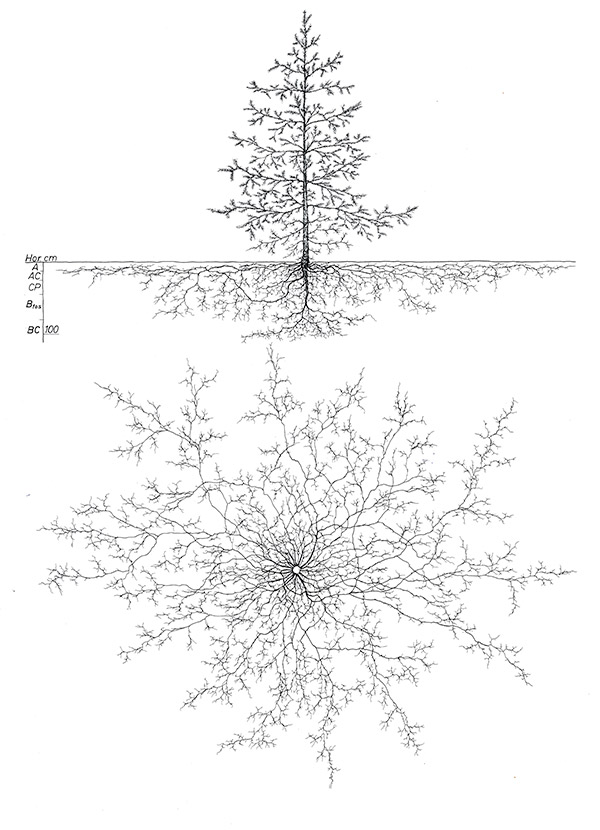
100cm equals three feet. More than 50% of the roots are in the top 18 inches. |